
The rise of Artificial Intelligence (AI) in recent years has been nothing short of spectacular. From text-generation apps like ChatGPT and DeepSeek to media generation tools like DALL-E and Sora - it has never been easier to generate new content.
But whilst we are being bombarded by new innovation after new innovation, many of us struggle to keep up with the ever-evolving definition and scope of AI, because "AI" means different things to different people.
Table of Contents
A messy set of definitions
The official definition of AI is broad, but when people talk about it, they are often referring to a very specific tool or domain, which can lead to confusion and apparent contradictions.
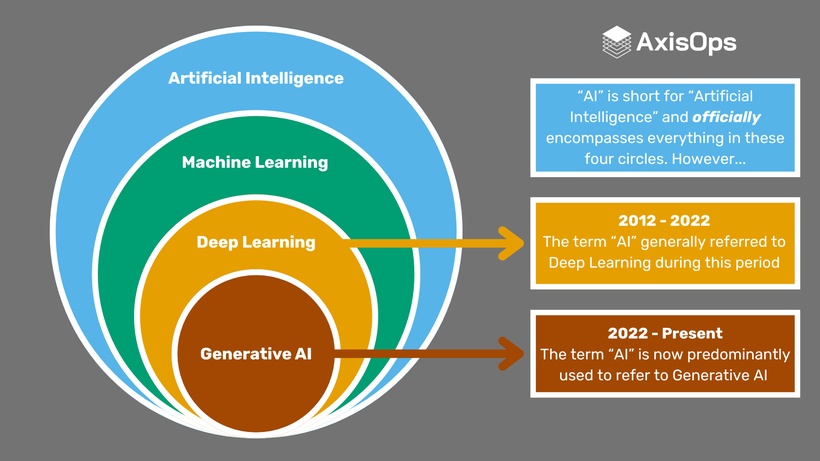
There are various different terms that look and sound similar. Let's have a look at some of the terms that are most relevant today:
- Artificial Intelligence
- Machine Learning
- Deep Learning
- Generative AI
These terms form a hierarchy - let's go through them one at a time.
What is Artificial Intelligence?
Artificial Intelligence (AI for short) refers to any piece of software that can mimic human intelligence. This covers everything from simple logic, to automatically creating digital art. The definition is vast, and even includes basic algorithms that are manually programmed and/or tuned by humans.
Some examples of Artificial Intelligence include:
- Bots that can play Sudoku or Chess
- Algorithms that plan and schedule your day
- Old "SatNav" devices that find the fastest route home
Artificial Intelligence doesn't have to be fancy
Artificial Intelligence doesn't have to be fancy, as you don't have to use any data to create it. For the programmers amongst us, even a traditional if statement or a for loop could technically be classified as "AI".
The problem is that the public perception of Artificial Intelligence is generally akin to advanced technologies like ChatGPT. Many companies are exploiting this association, by shouting about how they are leveraging "AI", when their underlying technology has changed very little in the last decade. A client may therefore expect to get something in the brown circle (in the image above) but in reality will get something in the blue zone instead.
It is therefore worth reflecting whether a company/product is really bringing anything novel or tangible to the table when they are referring to Artificial Intelligence.
What is Machine Learning?
Machine Learning is a subset of Artificial Intelligence where data is required to automatically calibrate how a model/algorithm behaves. These methods are extremely powerful as they allow us to automate processes that would be difficult or impossible to code up manually.
Some examples of Machine Learning include:
- Running/cycling apps that use data from research studies to approximate your level of fitness
- Banks that use transaction databases to predict whether your purchase is fraudulent or not
- Map apps that use historic traffic data to optimise routes by avoiding rush hour hotspots
All Machine Learning algorithms are AI, and many of them have been around since the advent of computers.
What is Deep Learning?
Deep Learning is a specific Machine Learning method that uses "Neural Networks" to make decisions. Neural networks are inspired by and structured like the human brain, whereby many "neurons" (brain cells) are connected to each other. Each neuron receives a set of input signals and it then decides whether to take action (activate) or not. For example, a neuron in your brain may receive signals from many different pain receptors throughout the body - it may then activate once the pain surpasses a certain threshold, prompting a different part of your brain to take action to reduce the pain.

The word "Deep" refers to the use of Neural Networks with multiple "layers" of neurons. More layers means more nuanced decisions can be made. For example, a bunch of neurons are activating due to pain, but another bunch of neurons are activating due to relaxation - this information can be collated by another set of neurons that might infer that you're having a massage so there's no need to take evasive action.
With Deep Learning, you typically have many thousands of neurons connected to each other, forming complicated webs that can, in principle, be moulded to serve any purpose.
It's important to note that Neural Networks are not always the perfect solution to a problem. For example, they can be applied to a problem that is easily solved by traditional machine learning methods, but they won't necessarily do as good a job. Neural networks can be likened to a 3D printer, which can print any DIY tool, but they probably won't be as good as tools you buy at a DIY store that were manufactured in a dedicated factory. However, Neural Networks are particularly good at performing extremely complicated tasks, where traditional Machine Learning methods aren't fit for purpose.
Some examples of Deep Learning include:
- Facial recognition software
- Self-driving cars that detect and classify objects around them
- "Recommended for you" web content
What is Generative AI?
Generative AI (or GenAI) uses Deep Learning methods to create brand new content, like text and media. These models are typically trained on huge datasets, requiring powerful supercomputers to recognise patterns and structures that can be exploited.
Listed below are some of the ground-breaking technologies that have been released in recent years:
| Technology | Examples |
|---|---|
| Text generation | ChatGPT & DeepSeek |
| Code generation | Claude & Codex |
| Image generation | DALL-E & Nano Banana |
| Audio generation | SUNO & ElevenLabs Music |
| Video generation | Sora & Veo |
| World generation | Genie 3 |
These technologies have taken the world by storm and have disrupted various industries, but they are also prone to issues such as "hallucinations" (more on this in a future blog).
Side-effects of using GenAI are yet to be fully understood. For example, this fantastic article discusses the potential cognitive implications for those who become dependent on Generative AI.
The ever-changing goalposts of the term "AI"
You could read articles about the pros and cons of "AI" from 2005, 2015, and 2025, and they would be talking about 3 fundamentally different technologies.
Despite the all-encompassing definition of Artificial Intelligence, the public perception of what "AI" is has been changing for decades.
Prior to 2010, the term Artificial Intelligence was reserved almost exclusively to the field of computer science, albeit with a few Sci-Fi appearances.
In the early 2010s, significant breakthroughs with neural networks put Deep Learning on the map - but with "AI" being used extensively to describe the technology, the term became synonymous with Deep Learning rather than the broader definition of AI.
The same happened in the early 2020s, when the releases of products like DALL-E and ChatGPT caused an explosion in the field of Generative AI. Today, whenever we read about "AI", we are almost always reading about Generative AI rather than the field as a whole.
You could therefore read articles about the pros and cons of "AI" from 2005, 2015, and 2025, and they would be talking about 3 fundamentally different technologies.
The situation is confusing at best and causes contradictions at worst - even the GenAI article referenced above falls into this trap. More specifically, the article presents a counter-argument that AI has bought huge benefits to various research fields like cancer detection and drug discovery. The problem is that these examples are NOT Generative AI, rather they are well-constrained Deep Learning applications. As such, they cannot and should not be compared with Generative AI - especially in an article focusing solely on the impacts of GenAI.
Closing thoughts
It is our hope that you now have a better understanding of the differences between what AI officially is and what AI actually means to most people. This will hopefully help you to see past apparent contraditions when AI is mentioned in the media and within society.
We have witnessed many different eras of AI progress, and the next decade will be no exception. The meaning of AI will therefore continue to evolve.
AI at AxisOps
At AxisOps we are AI experts, so we understand the benefits and risks of all technologies within the AI sphere.
We provide meaningful value to our clients in each layer of the aforementioned hierarchy:
| Technology | What we do |
|---|---|
| Artificial Intelligence | We have been making AI software since 2013. |
| Machine Learning | We have used ML to help clients leverage their datasets for insights and automation. |
| Deep Learning | We have the expertise to make powerful Neural Networks bespoke for your business needs. |
| Generative AI | We have a proven track record of integrating GenAI to automate complex processes and deliver exciting new products. |
Let's talk AI
AxisOps augments your teams with lead engineers and delivery experts who keep initiatives calm, transparent, and measurable.
Tell us what you're planning next and we'll help you pick the lowest-risk path to ship it.
Start your AI journey